Short Links Are More Than Fewer Characters
Shortening is the least interesting thing a short link does. A good one is readable, hard to mistype, permanent, checkable before you tap it and quiet about who follows it. Here is what that is worth, and what it deliberately leaves out.
14 January 2026 · 8 min read · updated 10 October 2026
The name is a problem. "URL shortener" describes the visible effect and misses most of the point, in the same way that calling a filing cabinet a "paper compressor" would be technically defensible and completely unhelpful.
Length does matter sometimes. An address with three path segments and four tracking parameters cannot be read out on a podcast, does not fit on a business card, and looks like a printing error in a conference programme. But length is why people first reach for a shortener. It is not the only thing a short link gives you, and on its own it is not a good enough reason to trust one.
This piece goes through what a short link on LinkMint actually provides, and is equally clear about what it does not.
Readability: an address a person can handle
Long URLs are written for machines. They carry content management paths, session details, tracking parameters and encoded characters, and they make perfect sense to the server that issued them. A person reading one off a poster, dictating it over the phone or copying it from a slide has a much harder time.
https://shop.example/collections/outdoor/spring-2026/boots?utm_source=flyer&utm_medium=print&utm_campaign=spring_launch
linkmint.org/k7Rmz
The second fits on a single line of a flyer at a sensible type size, can be read aloud in a few seconds, and leaves room in a QR code for a lower density pattern that scans more easily from a distance or at an angle. None of that changes where the link goes. It changes whether people get there.
Unambiguous characters: codes you can type off paper
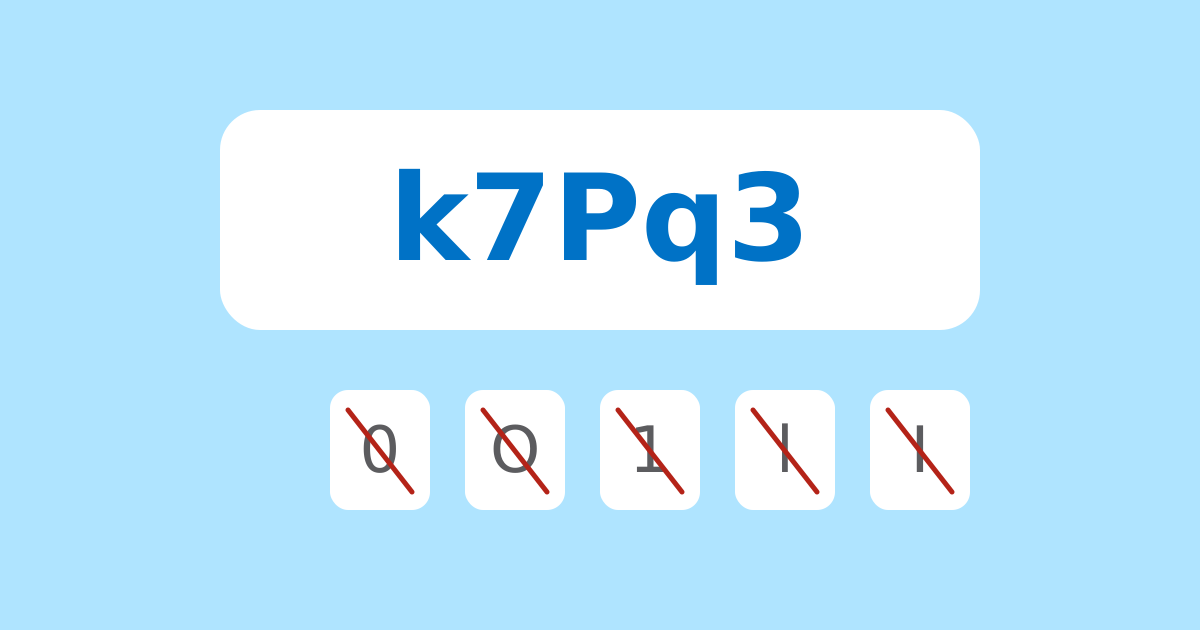
A short code is only useful if people can reproduce it. Some characters look almost identical in many typefaces: zero and capital O, the digit one, lower case l and capital I. A code containing them generates mistakes from anyone typing it off printed material, and nobody can tell from the printout which one was meant.
LinkMint codes are five characters drawn from an alphabet that leaves those characters out entirely. If you see something that looks like an O, it is not a zero, because there are no zeros. That is a small design decision with a large effect on real use, especially for codes read aloud, written by hand or printed in a decorative font.
Durability: an address that keeps working
Once a link is printed on packaging, read out on air or sent to a mailing list, it is out of your hands. The single most important property of a short link is that it keeps doing what it did on the day you made it.
- LinkMint links never expire. There is no expiry setting and no clean up of links that have not been visited for a while.
- Codes are never recycled. The code you were given will never be handed to anyone else, even if your link is disabled after an abuse review.
- Links cannot be deleted. Nobody, including whoever created the link, can remove it and free the address for reuse.
The recycling point deserves emphasis. On services that release old aliases, a printed link can end up pointing at a stranger's page. That is a real risk with anything that stays in circulation, and it is covered in detail in the piece on why deleted aliases should not be recycled.
Honesty requires one caveat. A short link adds a dependency: the link works because the short link service answers it. Durability is a promise about how the service treats your links, not a guarantee that no service ever goes away. For anything critical, it is sensible to also publish the full destination somewhere people can find it, such as your own website.
Trust: seeing the destination before you go
People have been told, correctly, to be wary of short links from senders they do not know. A short link hides its destination, and that is exactly what phishing relies on. Any short link service that wants to be trusted should give recipients a way to look before they leap.
On LinkMint, putting a plus sign in front of any code shows the full destination on a page of its own, without visiting it.
linkmint.org/k7Rmz     goes to the destination
linkmint.org/+k7Rmz    shows the destination and waits
Because LinkMint links cannot be edited, what the preview shows is what the link will always do. A preview on a service with editable links is only true until the next edit; here it stays accurate for the life of the link. If you share links with people who might be cautious, telling them about the plus sign costs one sentence.
Fidelity: your query string arrives intact
A large share of links worth shortening carry parameters: UTM tags for campaign tracking, product variants, signed download tokens, search filters. All of them depend on exact characters. A service that tidies URLs by reordering parameters, re-encoding characters or dropping ones it does not recognise can quietly break them.
LinkMint keeps the query string byte for byte. Whatever you paste is what the redirect sends people to. That makes it a sensible partner for the UTM builder: tag the URL there, hand it to the shortener, and the tags reach your analytics exactly as written, with a short code on the front instead of a hundred characters of parameters.
Privacy: nothing is recorded when someone follows a link
Many link services exist primarily to count. Each visit is logged with a time, an approximate location, a device type and often more, and the link becomes a small surveillance point between your audience and your page.
LinkMint records nothing when someone follows a link: no click counts, no cookies, no IP addresses. The server looks up the code, sends a 302 to the destination, and that is the end of its involvement. The people you share links with are not profiled on the way to your page.
The cost is that LinkMint cannot tell you how many people clicked. If you need to measure, measure where it belongs: on your own site, using the UTM parameters you added. Your analytics will attribute the visit to the campaign, source and medium you chose, and the short link in the middle stays out of it.
What a LinkMint link does not do: change destination
Editable short links are genuinely useful. On services that offer them, you can fix a typo after a flyer is printed, point a link at next season's page, or redirect a retired campaign somewhere sensible. If that flexibility is central to what you are doing, a tool with editable links is the right choice, and it is worth saying so plainly.
LinkMint deliberately does not offer them. The reason is accounts, or rather the absence of them. To let someone edit a link safely, a service has to know that the person editing is the person who created it. That means sign in, passwords, recovery, and everything that comes with storing who you are. Without accounts there is no proof of ownership, and an edit feature without proof of ownership would let anyone redirect anyone else's printed links. Fixed destinations are the honest consequence of not asking who you are.
There is also a benefit on the recipient's side. A fixed link is a promise. The person who checks it with the plus sign today can rely on it going to the same place tomorrow, and nobody can quietly swap a trusted destination for a malicious one later.
Planning around a fixed destination
If you want the effect of an editable link without the feature, put the flexibility on your own site. Point the short link at a stable address you control, such as yoursite.example/menu or yoursite.example/event, and change what that page shows whenever you need to. The short link never changes; the page behind it does. This works especially well for printed QR codes, where the short link is fixed in ink anyway.
What you get, and what you do not
| You get | You do not get |
|---|---|
| A five character code with no look-alike characters | A code you choose yourself |
| A link that never expires and is never recycled | A way to delete or edit the link |
| A preview of the destination with + before the code | Click counts or visitor statistics |
| Your query string kept byte for byte | Custom domains |
| No cookies, no IP logging, no account needed | Folders, tags or a dashboard |
A checklist before you share or print a short link
- Open the destination in a browser and let it settle. Shorten the final address, not one that redirects again.
- If you need to measure, add UTM parameters first, then shorten the tagged URL.
- Consider pointing at a stable page on your own site if the content may change later.
- Check the result with + in front of the code and confirm the destination is exactly right.
- For print, test the code by typing it from the proof, not by copying it.
- For anything critical, publish the full destination somewhere as well.
So what is a short link for?
A short link is an address designed for people rather than servers: short enough to print and say, built from characters that survive being retyped, permanent, open to inspection before anyone follows it, faithful to every parameter you included, and silent about who uses it. Being short is a side effect of being usable.
Which means the questions worth asking of any link tool are not about character counts. They are: will this address still work, and still mean the same thing, years from now? Can people check where it goes before they trust it? And what does the service learn about the people who follow it? LinkMint's answers are yes, yes and nothing.
Related reading
- What Happens Between Clicking a Short Link and Reaching the Page?
A short link feels instant, but a precise sequence runs in between: DNS, a secure connection, one lookup, a 302 and a second request. Here is each step, and what LinkMint does (and does not do) during it.
- Why Deleted Short-Link Aliases Shouldn't Be Recycled
Handing a retired short link code to someone new looks like tidy housekeeping. In practice it gives a stranger traffic that was meant for somebody else. Here is how that goes wrong, and why LinkMint never reuses a code.
- Dynamic vs Static Links: What Actually Changes?
Dynamic usually means a link whose destination you can change after publishing. Static means you cannot. Here is what that really costs, when each is right, and how to plan when all you have is static.